
What Should an HPC Cooling Benchmark Measure?
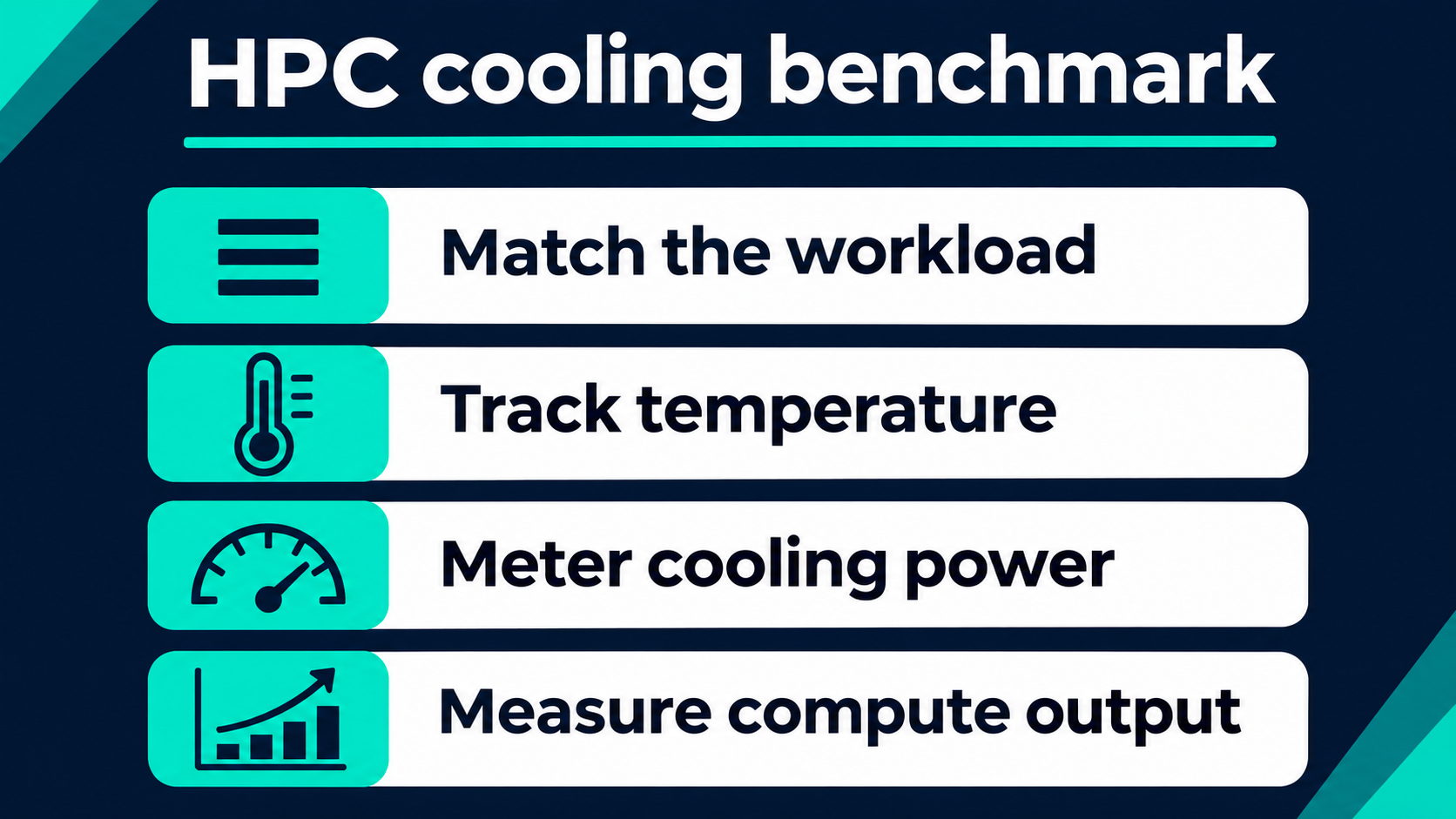
A useful cooling benchmark for high-performance computing (HPC) measures more than chip temperature. It records the workload or heat input, component temperature over time, cooling power, and how much useful work the system delivers. Without those measurements, it is hard to tell whether a cooler actually improved performance or whether the processor simply slowed down.
Set a fair baseline for an HPC cooling benchmark
Run the baseline and the candidate cooler on the same hardware and workload, with the same power limits and comparable inlet conditions. Record where temperature is measured, the start and end conditions, and the length of each run. If the comparison cannot hold a condition constant, document the difference so readers can judge its effect.
Measure temperature, power, and output together
- Temperature: Record both the stabilized temperature and the peak during a load change. Note inlet air or coolant temperature, as applicable, so the result has a reference point.
- Cooling power: State what the meter includes. Count fans, pumps, and other cooling equipment inside the test boundary. If a shared external system is excluded, say so.
- Useful output: On working compute hardware, log throughput and any thermal throttling. On a heater-based bench, record the applied heat instead. A heater test cannot tell you how fast a server will run.
Repeat the run and report the limits
Test both sustained load and a repeatable load change. Repeat each condition and report the spread between runs, along with known sensor limitations. A bench result can inform a decision about further testing, but it cannot establish rack-scale performance or facility power usage effectiveness (PUE).
For facility-scale context, see the U.S. Department of Energy’s High Performance Computing Data Center Metering Protocol. This article describes a benchmarking approach, not measured Waffle-Grid™ results.
Planning a comparison or an independent bench test? Contact Enoch Thermal about engineering evaluation.
Frequently asked questions about HPC cooling benchmarks
How do you compare two HPC cooling solutions fairly?
Use the same hardware, workload and power limits. Match the inlet conditions as closely as possible, and report temperature, cooling power and useful output over the same test window.
What counts as cooling power?
Cooling power is the electrical draw of the cooling equipment included in the measurement, such as its fans or pumps. Clearly list any shared or external equipment you did not meter.
Can a bench test establish data center PUE?
No. Power usage effectiveness (PUE) is the ratio of total facility energy to IT equipment energy over the same period. A bench test can compare components under controlled conditions; it does not measure the entire facility.